A Technology of Staying
From kneading dough to sharing a meal, Andoni Munduate Dorronsoro shares how technology deals with embodied knowledge, gestures and social practices. Food Hack Lab lens is interested in how tools shape culture and how being together in a Sobremesa can become a form of making too.
A Technology of Staying
From kneading dough to sharing a meal, Andoni Munduate Dorronsoro shares how technology deals with embodied knowledge, gestures and social practices. Food Hack Lab lens is interested in how tools shape culture and how being together in a Sobremesa can become a form of making too.
Published October 8, 2026
Author: Andoni Munduate Dorronsoro Co-founder, Food Hack Lab
Credit image: Andoni Munduate Dorronsoro
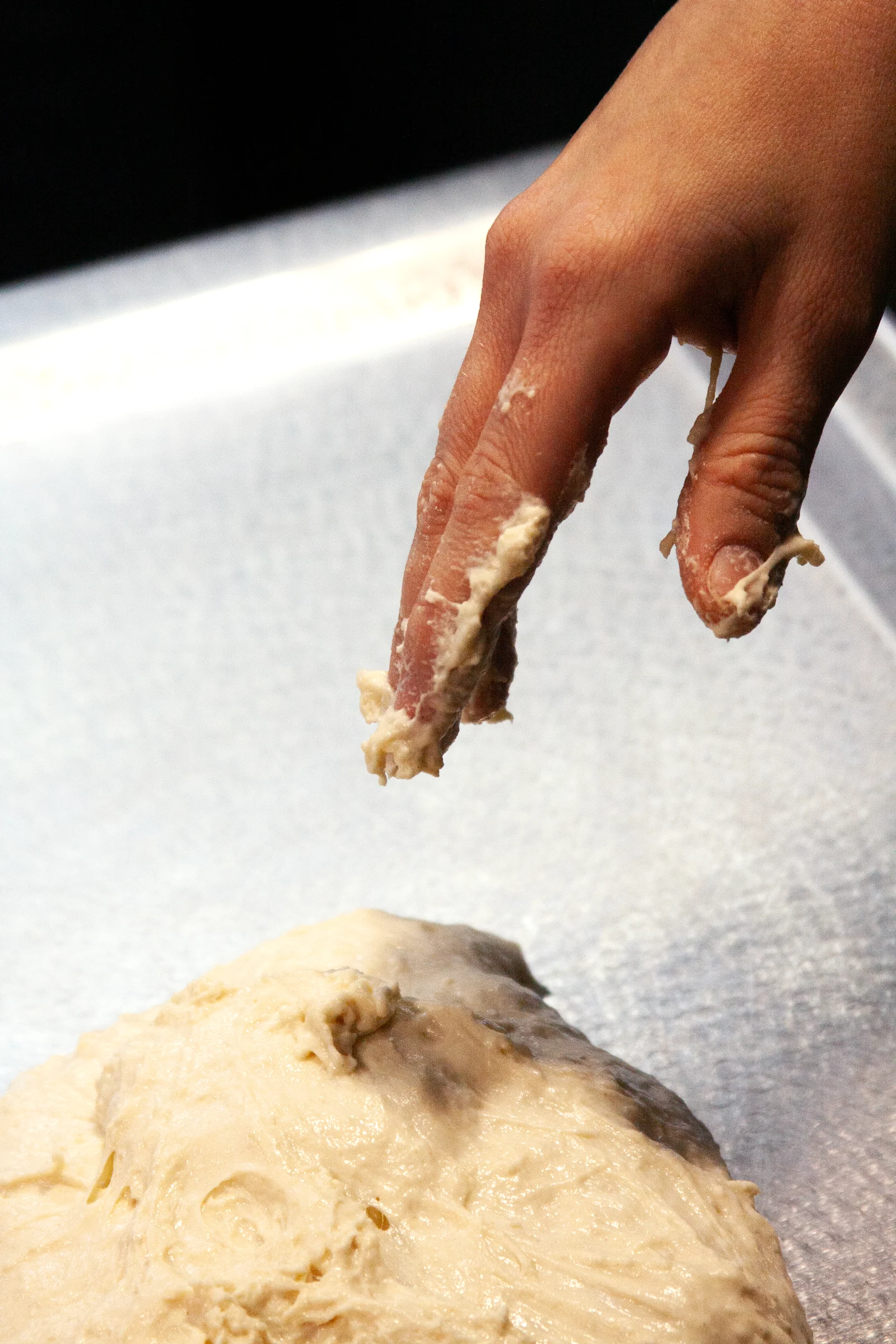
Dough resists. At first it sticks to your fingers and seems unlikely ever to come together. Then something shifts: the flour drinks the water, the hands find a rhythm, and the dough is no longer shapeless. Someone who knows how to knead can feel that moment before they can explain it. Their hands know.
You also have to know when to pick a tomato. The calendar is not enough. You have to look at the tomato, look at the sky, touch the soil and feel its dampness, smell the leaves and branches. Someone learnt to read all these signs.
For us, technology can mean all of that: the know-how held in a recipe, a gesture, a way of paying attention. It can also mean a machine, a tool, a contraption whose purpose is not immediately clear and which we are already wondering how to take apart. We are fond of gadgets. Perhaps fond is too mild. We are techno-fetishists of the first order. We are Basque, after all: show us a Caravaggio or serve us a Fergus Henderson dish and before long a Basque will ask, “So, how did they make it?”
The word technology has old relatives in craft, skill, the art of making. It also carries a hint of giving an account of a craft: putting what we do into words. That may be too tidy a story about a word. Words are rarely so helpful. Still, the thought is useful.
A recipe is a technology. Not because it is about food, but because it gives a way of giving something a form that can travel. It might be a list of ingredients, a few hurried lines, or a painstaking account of an afternoon’s work. It can make six hours fit into a sentence.
Think of a recipe, an academic paper on growing lettuce hydroponically, and IKEA assembly instructions. Different voices, different ambitions, different amounts of detail. One offers measurements and a sequence; another describes a method; another turns a pile of boards into numbered pictures. Each tries to send a way of doing something beyond the person who first worked it out.
And still, something escapes the page. The temperature of the room, the sound of a simmer, the hand that knows when the dough is ready. A baker has spent years talking about bread; you can read his instructions and still need someone to show you with their hands.
And what about sobremesa? Could that be a technology too?
The meal ends. We could get up. Often, we don’t. Someone clears the plates, someone brings the coffee, someone tells a story we have heard before and that, for some reason, sounds different today. The practical business of eating is over, and still we stay.
For what? Perhaps to keep the encounter going a little longer. To turn food into conversation, company into shared memory, spare time into time spent together. To hear what did not fit between the first bite and the last. To tell a story, keep an argument alive, postpone the goodbye. Or simply because no one has yet stood up. A tool does not need to produce a useful object every time. Or does it?
Maybe sobremesa is a way of doing something with the time left after we have eaten. We learn it from other people, alter it, pass it on. Its shape changes from one table to the next, as do the stories, the silences and the people who get to stay. Perhaps, in these ordinary ways of being together, we become a little more ourselves. This is a lot to ask of coffee, admittedly.
So what are we doing here, Food Hack Lab, in a project called SOBREMESA? We like tools, and we like finding out how things are made. Perhaps we are also interested in the tools that do not look like tools at all: a recipe, a shared meal, a habit of staying. We make such tools, and they make something of us. Or perhaps we just like eating and talking for hours. That may be the whole explanation.
We could take the idea further. Imagine a high-tech sobremesa: sensors that detect when conversation is flagging; an artificial intelligence that finds the memory five strangers have in common; an app that recommends exactly when to pour another coffee. The machine might recognise a pause. We do not know whether it would understand why someone needs one.
For now, the coffee is going cold. Someone is making more. No one seems in a hurry.
Published October 8, 2026
Author: Andoni Munduate Dorronsoro Co-founder, Food Hack Lab
Credit image: Andoni Munduate Dorronsoro
Dough resists. At first it sticks to your fingers and seems unlikely ever to come together. Then something shifts: the flour drinks the water, the hands find a rhythm, and the dough is no longer shapeless. Someone who knows how to knead can feel that moment before they can explain it. Their hands know.
You also have to know when to pick a tomato. The calendar is not enough. You have to look at the tomato, look at the sky, touch the soil and feel its dampness, smell the leaves and branches. Someone learnt to read all these signs.
For us, technology can mean all of that: the know-how held in a recipe, a gesture, a way of paying attention. It can also mean a machine, a tool, a contraption whose purpose is not immediately clear and which we are already wondering how to take apart. We are fond of gadgets. Perhaps fond is too mild. We are techno-fetishists of the first order. We are Basque, after all: show us a Caravaggio or serve us a Fergus Henderson dish and before long a Basque will ask, “So, how did they make it?”
The word technology has old relatives in craft, skill, the art of making. It also carries a hint of giving an account of a craft: putting what we do into words. That may be too tidy a story about a word. Words are rarely so helpful. Still, the thought is useful.
A recipe is a technology. Not because it is about food, but because it gives a way of giving something a form that can travel. It might be a list of ingredients, a few hurried lines, or a painstaking account of an afternoon’s work. It can make six hours fit into a sentence.
Think of a recipe, an academic paper on growing lettuce hydroponically, and IKEA assembly instructions. Different voices, different ambitions, different amounts of detail. One offers measurements and a sequence; another describes a method; another turns a pile of boards into numbered pictures. Each tries to send a way of doing something beyond the person who first worked it out.
And still, something escapes the page. The temperature of the room, the sound of a simmer, the hand that knows when the dough is ready. A baker has spent years talking about bread; you can read his instructions and still need someone to show you with their hands.
And what about sobremesa? Could that be a technology too?
The meal ends. We could get up. Often, we don’t. Someone clears the plates, someone brings the coffee, someone tells a story we have heard before and that, for some reason, sounds different today. The practical business of eating is over, and still we stay.
For what? Perhaps to keep the encounter going a little longer. To turn food into conversation, company into shared memory, spare time into time spent together. To hear what did not fit between the first bite and the last. To tell a story, keep an argument alive, postpone the goodbye. Or simply because no one has yet stood up. A tool does not need to produce a useful object every time. Or does it?
Maybe sobremesa is a way of doing something with the time left after we have eaten. We learn it from other people, alter it, pass it on. Its shape changes from one table to the next, as do the stories, the silences and the people who get to stay. Perhaps, in these ordinary ways of being together, we become a little more ourselves. This is a lot to ask of coffee, admittedly.
So what are we doing here, Food Hack Lab, in a project called SOBREMESA? We like tools, and we like finding out how things are made. Perhaps we are also interested in the tools that do not look like tools at all: a recipe, a shared meal, a habit of staying. We make such tools, and they make something of us. Or perhaps we just like eating and talking for hours. That may be the whole explanation.
We could take the idea further. Imagine a high-tech sobremesa: sensors that detect when conversation is flagging; an artificial intelligence that finds the memory five strangers have in common; an app that recommends exactly when to pour another coffee. The machine might recognise a pause. We do not know whether it would understand why someone needs one.
For now, the coffee is going cold. Someone is making more. No one seems in a hurry.