About
"Exclusion by those at the table doesn't depend on willful intent; we don't have to intend to exclude for the results of our actions to be exclusion."
- Robin DiAngelo
WHAT IS SOBREMESA
Sobremesa: Vagaries of the Palate is a project which lingers post-meal, post-action, at the afterparty, and post-performance, in spaces where guards lower and the metaphorical seat at the table showcases the failings of the project of integration. Food here refuses neutrality: not mere conviviality or cultural diffusion, but a charged medium, material witness to nation-states and their identity construction.
Currently in its pilot phase, starting in Southern Europe, across Greece, Italy, Portugal, and the Basque region of Spain, whose borders are increasingly less permeable to the south of the south and east of east, the project acknowledges cuisines as constructions that discount their mobility shaped by displacement, trade routes, and survival tactics – on the one hand diluting incoming food cultures while on the other hand entirely excluding them from the table. The question is not simply who gets a seat at the table, but where and when the table begins and ends.
"Exclusion by those at the table doesn't depend on willful intent; we don't have to intend to exclude for the results of our actions to be exclusion."
- Robin DiAngelo
WHAT IS SOBREMESA
Sobremesa: Vagaries of the Palate is a project which lingers post-meal, post-action, at the afterparty, and post-performance, in spaces where guards lower and the metaphorical seat at the table showcases the failings of the project of integration. Food here refuses neutrality: not mere conviviality or cultural diffusion, but a charged medium, material witness to nation-states and their identity construction.
Currently in its pilot phase, starting in Southern Europe, across Greece, Italy, Portugal, and the Basque region of Spain, whose borders are increasingly less permeable to the south of the south and east of east, the project acknowledges cuisines as constructions that discount their mobility shaped by displacement, trade routes, and survival tactics – on the one hand diluting incoming food cultures while on the other hand entirely excluding them from the table. The question is not simply who gets a seat at the table, but where and when the table begins and ends.
What does Sobremesa do
Sobremesa develops research methodologies, artistic practices, and mechanisms for examining how cultural identities are constructed, circulated, and transformed through the lens of food practices. Its pilot phase brings together artists, researchers, cultural practitioners, policy-makers, and communities across Southern and South Eastern Europe to test what becomes possible when research is conducted transnationally rather than through fixed national frameworks, towards developing alternative methodologies for confronting hegemonic cultural identity.
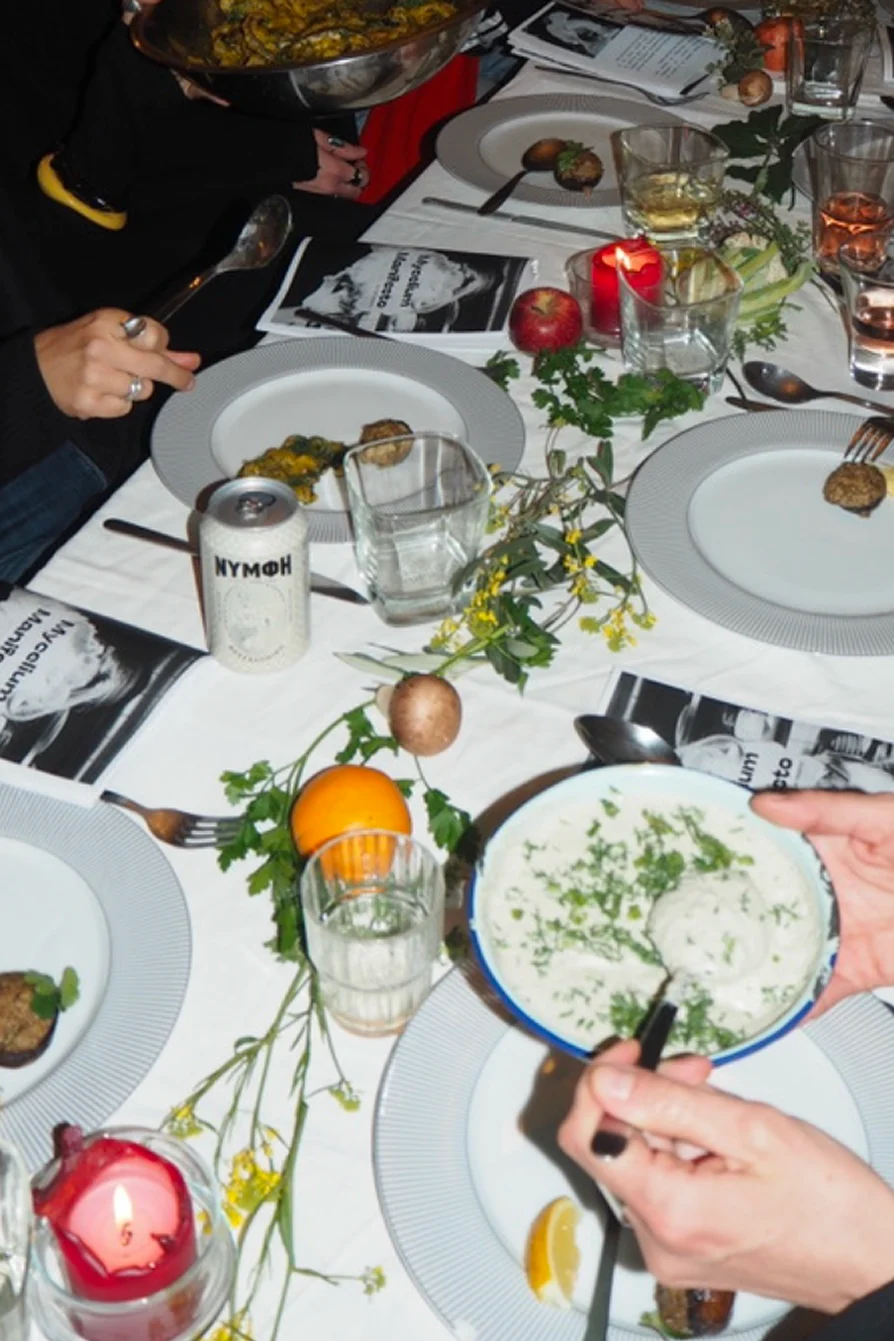
Through site-specific residencies, comparative research, dialogue, exchange, public programmes, and policy-level shifts, the project creates situations in which divergent understandings of food, heritage, and belonging can encounter one another. The post-meal moment becomes a methodological condition: not a space of consensus but one in which contradiction, memory, disagreement, and exchange can be productive.
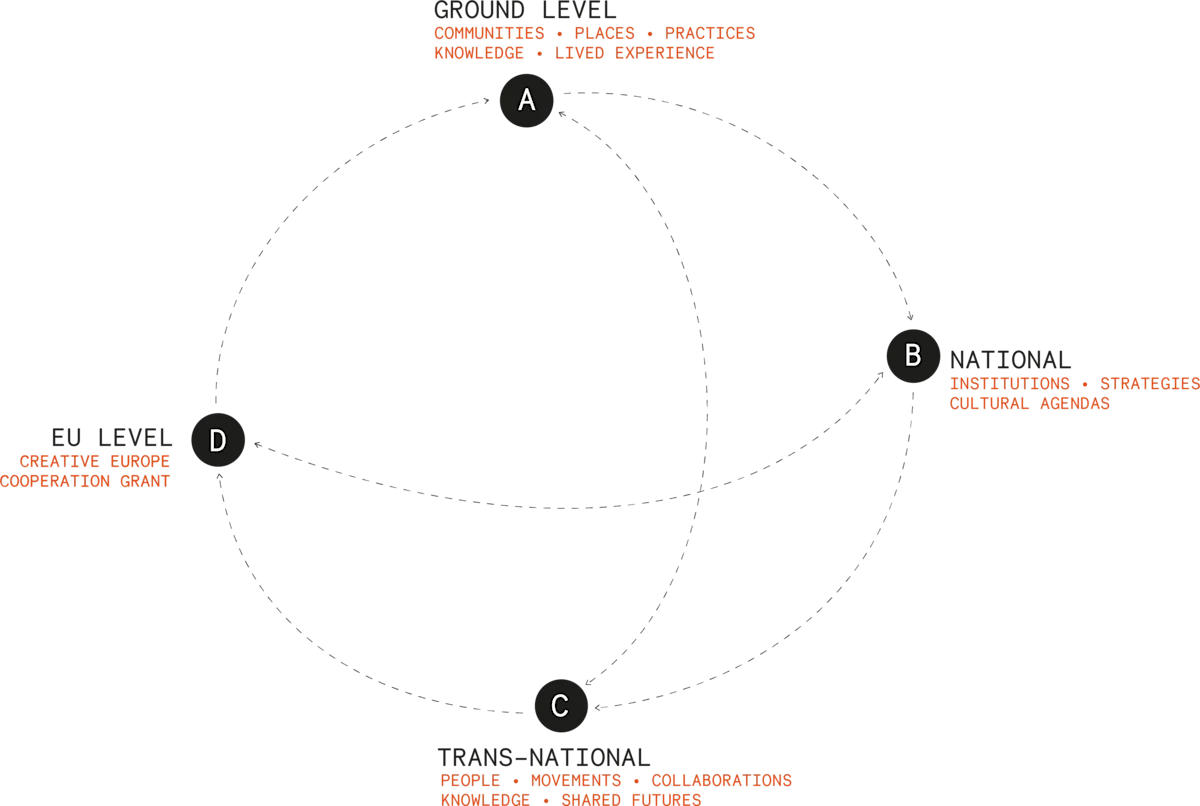
Working across local, national, and transnational scales, Sobremesa traces how culinary practices shift, change, and acquire meaning – producing research, frameworks, and tools that can inform geopolitical turns and contribute to contemporary concerns within and beyond the context of the EU.
Co-Funded by the European Union. Views and opinions expressed are however those of the author(s) only and do not necessarily reflect those of the European Union or the European Education and Culture Executive Agency (EACEA). Neither the European Union nor EACEA can be held responsible for them.
The views and opinions published here mirror the principles of academic freedom and do not necessarily reflect the views or positions of Institution(ing)s and its members.
The contents of this platform are published according to the terms of the Creative Commons Share Alike License unless otherwise mentioned.
What does Sobremesa do
Sobremesa develops research methodologies, artistic practices, and mechanisms for examining how cultural identities are constructed, circulated, and transformed through the lens of food practices. Its pilot phase brings together artists, researchers, cultural practitioners, policy-makers, and communities across Southern and South Eastern Europe to test what becomes possible when research is conducted transnationally rather than through fixed national frameworks, towards developing alternative methodologies for confronting hegemonic cultural identity.
Through site-specific residencies, comparative research, dialogue, exchange, public programmes, and policy-level shifts, the project creates situations in which divergent understandings of food, heritage, and belonging can encounter one another. The post-meal moment becomes a methodological condition: not a space of consensus but one in which contradiction, memory, disagreement, and exchange can be productive.
Working across local, national, and transnational scales, Sobremesa traces how culinary practices shift, change, and acquire meaning – producing research, frameworks, and tools that can inform geopolitical turns and contribute to contemporary concerns within and beyond the context of the EU.
Co-Funded by the European Union. Views and opinions expressed are however those of the author(s) only and do not necessarily reflect those of the European Union or the European Education and Culture Executive Agency (EACEA). Neither the European Union nor EACEA can be held responsible for them.
The views and opinions published here mirror the principles of academic freedom and do not necessarily reflect the views or positions of Institution(ing)s and its members.
The contents of this platform are published according to the terms of the Creative Commons Share Alike License unless otherwise mentioned.
Project Partners


Special thanks
Soumyabuddha Debnath, Michiel Jansen, Bedirhan Sen, Lia Reihtner, Mirna Bamieh
Project consultants
Suruchi Pawar, Federico Rudari, Luísa Santos, Rissa Miller, Diane Giraud, Pino Ficara, Johnny Madge, Federico Bossone
CONTACTS
For general inquiries and participation requests, please reach out to: INFO@SOBREMESAproject.COM aishwarya@sobremesaproject.com
For project-specific information, please contact the project lead:
CONTACTS
For general inquiries and participation requests, please reach out to: INFO@SOBREMESAproject.COM aishwarya@sobremesaproject.com
For project-specific information, please contact the project lead: