My carbonara? It’s better with store-bought speck.
From lessons learned by eating food cooked by others to words left out of official conversations, Aishwarya Kumar, Sobremesa’s artistic director, explores the table as a place of learning and a space for differences and truth, even at the risk of being challenged.
My carbonara? It’s better with store-bought speck.
From lessons learned by eating food cooked by others to words left out of official conversations, Aishwarya Kumar, Sobremesa’s artistic director, explores the table as a place of learning and a space for differences and truth, even at the risk of being challenged.
Published October 1, 2026
Author: Aishwarya Kumar Artistic Director, Sobremesa
Credit image: Maria Giovanna Giugliano
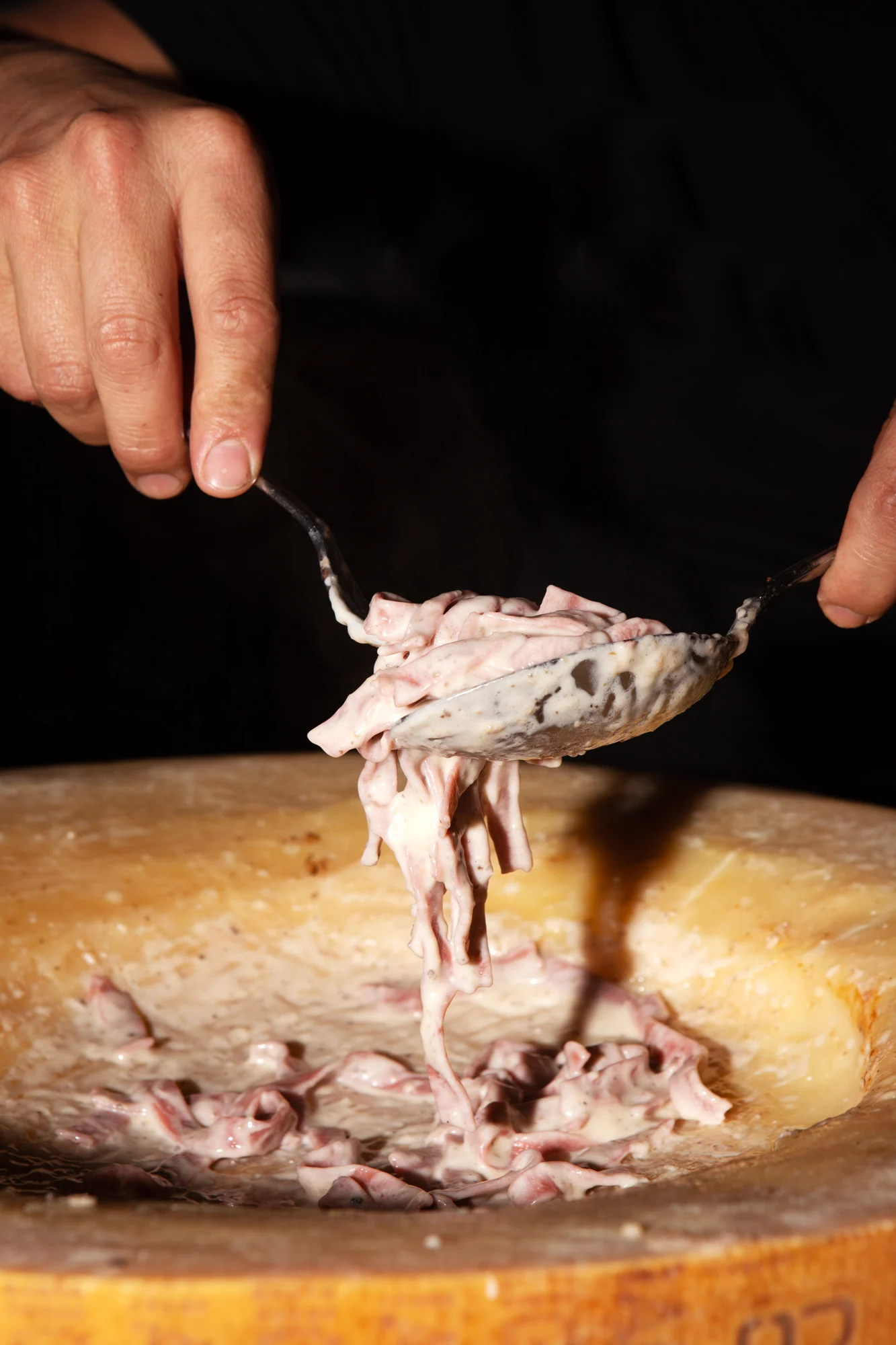
Things I learned by being cooked for, like a butter and flour roux is better than cornstarch for soups; that grilled cheese is supposed to be cooked low and slow, like bhindi when kept in vinegar for 30 minutes reduces the sliminess; like chicken soup left to cook overnight allows for a gelatinous pool I’d swim in; that aglio e olio is better with anchovies in the base; and that oil, if added at already high heats doesn’t really get absorbed, the same for butter - except that butter burns. That steak is only ever really good if it’s filet mignon but more recently entrecote works too; that red sauce needs to have canned tomatoes and red wine aged for at atleast 2 years, that the red wine ideally be Valpolicella; that spaghetti can never have too much salt when being cooked; milkshakes have ice icecream, that sabudana, chole, and rajma must be soaked long enough and yet not too long; that dosa is generally preferred over idli; that there are two kinds of potatoes (kruimig of neit kruimig); that butter isn't really fatty; and that the dosa pan must always be rubbed with onion before the first pour; that boiled squid and gochujang are a strong union; that garlic soaked in olive oil makes for a great spread; that sambal goes with peanut sauce; that lemon on shrimp soothes the allergy; that carbonara is better with store-bought speck; that Amari is preferred fresh, that whikey and gin were sidelined for white wine, "that perfection can be achieved at any level of cuisine – the search for the perfect frikandel speciaal"; and that I learn a lot more about cooking than you thought I would just by being fed.
One would think that being in contact with the arts, formerly through dance (since the age of 7), transitioning into transmedial practices and philosophy in one’s 20s would provide a harmonious relationship with words. Far from it, classical arts and academic discourse often, while providing an intensity and influx of various ways of knowing, have brought an internal, contradictory, and irreconcilable emotion with words – used too much and, at the same time, not enough. A frustration I often temper by doing two activities at the same time: listening to a lecture while doing my laundry, having a show run in the background while I read a text, or reading a book around a family discussion.
The tempering is more for the sake of being able to digest what the words offer without losing hope in commodified sentiments, which is oftentimes a voice without inflexion – a combination of things said by multiple others. The tempering is for the sake of the off chance that there is something in those 400 pages, a single sentence even, that allows a new neural pathway to be recognised by me a few months down the road. Entering with frustration would be a hindrance to the subconscious absorption of that. That is my Sobremesa, a moment to be able to be, at different moments and in different ways, engaged in multiple dialogues about the same thing - with the shifts in emotion, agreeability, tone, and relationships. A living moment where we get to hear what it is that goes unsaid at the table out of politeness. There is something about the psychogeography of the apparatus that is a table or equivalent – as a space between me and someone – that allows for temperance and affords a more clandestine space to discuss that which seems to be too large to tackle in meetings, boardrooms, and conferences.
To say that my affections for Sobremesa come from a leaning towards conviviality or collective processes would be somewhat misleading. It comes from the search for ways of coming together (even those which recognise difference) which aren’t coerced, performative, or leading with similar choreographies of hospitality which dinners offer. Stephanie Camp, in her 2004 book Closer to Freedom, discusses the notion of geographies of containment, a manner of continuing the otherness that contributed to the mechanisms of slavery.
Borrowing from this, the method-making intention of the concept critiques contemporary decolonial work that slips into a neoliberal framework which invites difference while choreographing it into safe, consumable forms. I hope this critique carries into further research and into the civic intention of the project. At many levels, Sobremesas are, for me, moments and ways to practice parrhesia – truth-telling – not only at the risk of being questioned but because of it.
Published October 1, 2026
Author: Aishwarya Kumar Artistic Director, Sobremesa
Credit image: Maria Giovanna Giugliano
Things I learned by being cooked for, like a butter and flour roux is better than cornstarch for soups; that grilled cheese is supposed to be cooked low and slow, like bhindi when kept in vinegar for 30 minutes reduces the sliminess; like chicken soup left to cook overnight allows for a gelatinous pool I’d swim in; that aglio e olio is better with anchovies in the base; and that oil, if added at already high heats doesn’t really get absorbed, the same for butter - except that butter burns. That steak is only ever really good if it’s filet mignon but more recently entrecote works too; that red sauce needs to have canned tomatoes and red wine aged for at atleast 2 years, that the red wine ideally be Valpolicella; that spaghetti can never have too much salt when being cooked; milkshakes have ice icecream, that sabudana, chole, and rajma must be soaked long enough and yet not too long; that dosa is generally preferred over idli; that there are two kinds of potatoes (kruimig of neit kruimig); that butter isn't really fatty; and that the dosa pan must always be rubbed with onion before the first pour; that boiled squid and gochujang are a strong union; that garlic soaked in olive oil makes for a great spread; that sambal goes with peanut sauce; that lemon on shrimp soothes the allergy; that carbonara is better with store-bought speck; that Amari is preferred fresh, that whikey and gin were sidelined for white wine, "that perfection can be achieved at any level of cuisine – the search for the perfect frikandel speciaal"; and that I learn a lot more about cooking than you thought I would just by being fed.
One would think that being in contact with the arts, formerly through dance (since the age of 7), transitioning into transmedial practices and philosophy in one’s 20s would provide a harmonious relationship with words. Far from it, classical arts and academic discourse often, while providing an intensity and influx of various ways of knowing, have brought an internal, contradictory, and irreconcilable emotion with words – used too much and, at the same time, not enough. A frustration I often temper by doing two activities at the same time: listening to a lecture while doing my laundry, having a show run in the background while I read a text, or reading a book around a family discussion.
The tempering is more for the sake of being able to digest what the words offer without losing hope in commodified sentiments, which is oftentimes a voice without inflexion – a combination of things said by multiple others. The tempering is for the sake of the off chance that there is something in those 400 pages, a single sentence even, that allows a new neural pathway to be recognised by me a few months down the road. Entering with frustration would be a hindrance to the subconscious absorption of that. That is my Sobremesa, a moment to be able to be, at different moments and in different ways, engaged in multiple dialogues about the same thing - with the shifts in emotion, agreeability, tone, and relationships. A living moment where we get to hear what it is that goes unsaid at the table out of politeness. There is something about the psychogeography of the apparatus that is a table or equivalent – as a space between me and someone – that allows for temperance and affords a more clandestine space to discuss that which seems to be too large to tackle in meetings, boardrooms, and conferences.
To say that my affections for Sobremesa come from a leaning towards conviviality or collective processes would be somewhat misleading. It comes from the search for ways of coming together (even those which recognise difference) which aren’t coerced, performative, or leading with similar choreographies of hospitality which dinners offer. Stephanie Camp, in her 2004 book Closer to Freedom, discusses the notion of geographies of containment, a manner of continuing the otherness that contributed to the mechanisms of slavery.
Borrowing from this, the method-making intention of the concept critiques contemporary decolonial work that slips into a neoliberal framework which invites difference while choreographing it into safe, consumable forms. I hope this critique carries into further research and into the civic intention of the project. At many levels, Sobremesas are, for me, moments and ways to practice parrhesia – truth-telling – not only at the risk of being questioned but because of it.