Lingering at a time of delegated hospitality
What tensions arise between the security-oriented framing of European funding initiatives and the continued emphasis among cultural producers on cooperation, diversity, and social cohesion?
Lingering at a time of delegated hospitality
What tensions arise between the security-oriented framing of European funding initiatives and the continued emphasis among cultural producers on cooperation, diversity, and social cohesion?
Published October 22, 2026
Aishwarya Kumar, sobremesa project lead
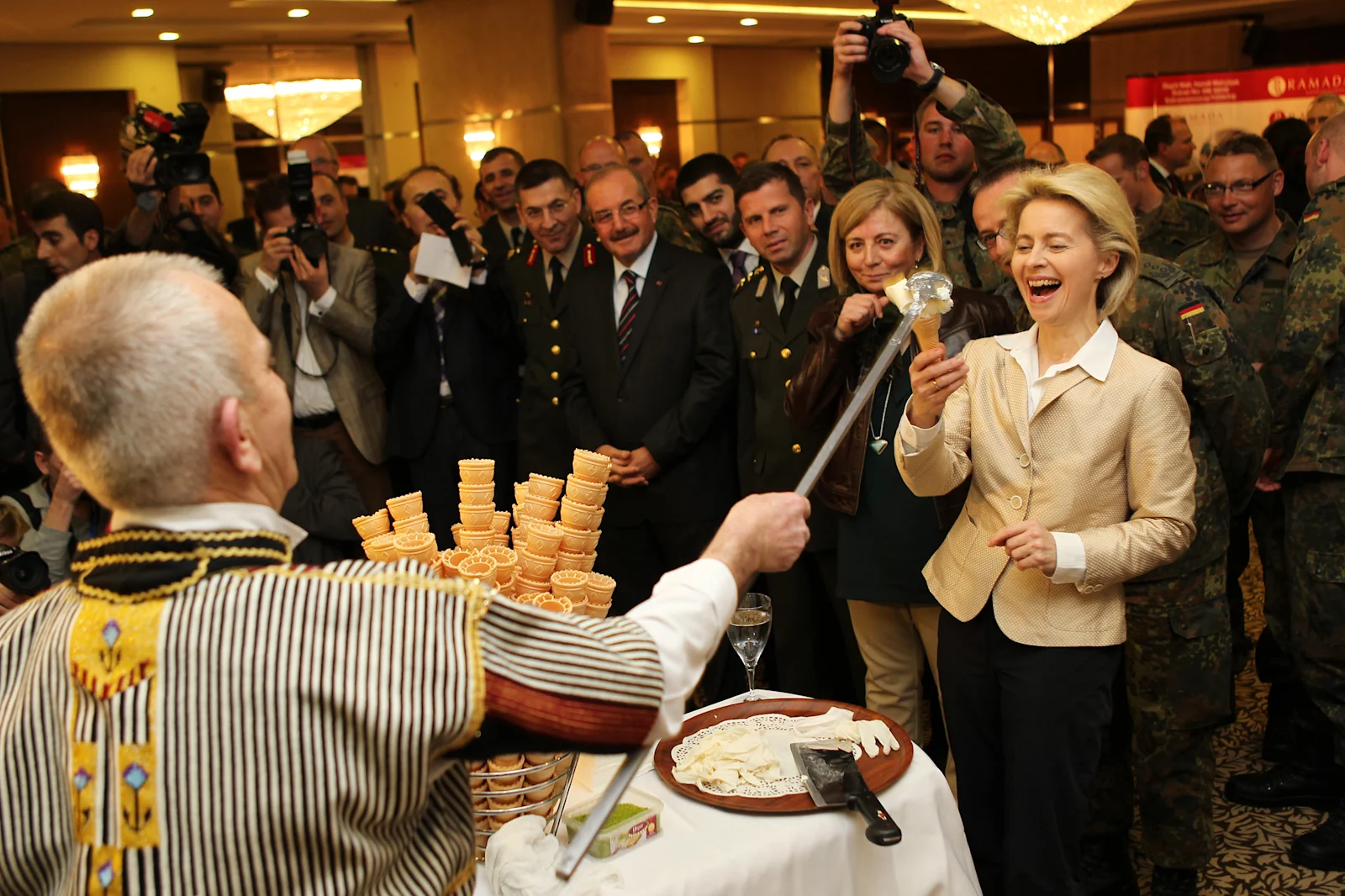
Credit image: Bundeswehr/Carsten Vennemann
During a summer programme in Copenhagen, I was a witness to the confession of someone in relation to advice given to a refugee in Germany. As it goes, the narrator was asked if it was conducive to come to Germany and go through the asylum process to gain, as one would imagine, a safer life than the one she had in Gaza. The narrator expressed a convincing no to the effect that undergoing this process not only aged you by decades but also that it would strip the woman of functioning as a researcher, writer, and thinker, aspects of her that were operating even under the state of war. That staying in a warzone was considered better for a fuller life than coming to Europe and experiencing a Sisyphean life, which highlights a contradictory reality of what a place says it is about and how it is experienced.
In her 2026 State of the Union address, Ursula von der Leyen captured a political tension: “The state of our Union is the strongest it has ever been. The state of our Union can also feel as precarious as it has ever been” (von der Leyen 2026). The statement presents a Europe that asserts resilience while confronting uncertainty around democracy, social policy, border control, security, and defence. Further reading points to the administrative and political infrastructures through which European migration policy is produced: highly organised and seemingly straightforward rules-based systems whose procedures and effects can remain difficult to trace. This difference in pace, the rapid geopolitical shifts with the slowness in internal decision-making, has caused, quite simplistically, two camps – those for whom European competitiveness and hard power is the imperative and those for whom those very values risk losing long-standing EU values of democracy. This tension is particularly visible if one is to consider the reality of cultural projects that address migration, integration, and belonging – projects that are funded by the Commission to showcase their work in areas of digital and green transition, diversity, and transnational partnerships. While requiring cultural producers to continue to promote cooperation, diversity, and social cohesion, do such support structures distract from policy increasingly shaped by security-oriented infrastructures?
This isn’t a nihilistic piece, or at least isn’t meant to be one. Yet, even a crash course in the funding, policy, and international relations agenda of Europe can activate the fight-or-flight-or-freeze experience in the cultural sector. Let’s take the example of a consortium-led Sobremesa: Vagaries of the Palate, which enters this terrain through the practice of lingering: the time after a meal when people remain at the table, speak, listen, and allow relations to continue beyond necessity - beyond politeness. Co-funded by the EU and concerned with migration, integration, and belonging, the project asks what transnational relation can mean at a moment when European border policy is increasingly structured around exclusion, removal, and externalisation. This tension becomes particularly visible in light of the EU’s emerging return-hub framework. How can the EU support projects centred on diversity and integration while member states simultaneously develop mechanisms intended to make certain people’s continued presence in Europe impossible?
It is important to disclaim the actuality of the return hub as of today. While the model has been agreed upon, while five countries of the EU are advocating for this model to be installed, while this decision-making process escaped the very many rules-based processes of the EU, and while it hasn’t been fleshed out entirely yet – it has been imagined, and pen has been put to paper and as of September 2026, the five participating states have agreed on a political model and are seeking a third-country partner; they have discussed concluding an agreement around the turn of 2026–27 and beginning transfers later in 2027. This should be distinguished from the legal adoption and entry into force of the EU framework and from actual implementation. (Reuters 2026; SWP 2026).
Conceptually and structurally, the return hub is a safe place of reception in a third country (not the home country) outside the EU, potentially equipped to provide physical, psychological, and emotional security for immigrants with no legal right to stay in the EU. Yet the terms through which safety would be guaranteed remain unclear. The arrangement appears to depend on one country making a person receivable and another making that person’s continued presence in Europe impossible. The individual is subject to a removal decision made within the European legal order while being transferred to a facility outside European territory. This arrangement reflects Europe’s desire to reconfigure diplomatic efforts with global partners through new forms of international cooperation.
How can Europe continue to present itself as a guardian of democratic principles while delegating the infrastructures of hospitality? What lies behind the promotion of transnational cooperation at a time of intensified regulation, border control, and externalisation? Can hospitality be delegated? Can it be outsourced?
In light of this thought experiment (a word often used at afterparties), developing projects under the EU’s Creative Europe programme – which supports cooperation across culture, MEDIA, and cross-sectoral initiatives as part of European democratic, innovation, environmental, and international policy – appears as a distinct strategy. It differs from more conventional forms of communication, surveying, and policy research by treating cultural practice as a site where political assumptions can be made visible. Yet the parallel existence of return hubs and Sobremesa also produces discomfort. Sobremesa names the time after a meal in which people remain at the table, while the return-hub policy is orientated towards removal and the termination of presence. The project can therefore appear, at best, out of touch with the political conditions surrounding it and, at worst, implicated in the neoliberalisation of cultural production. The question is not only who is allowed to remain at the table, who is given access, and what level of difference is considered acceptable.
In Of Hospitality (2000), Derrida traces an aporia – an internal contradiction – within hospitality by drawing out the irreconcilable distinction between conditional and unconditional hospitality. This is the tension that Derrida names through the relation between hospitality and hostility, or through the neologism hostipitality. The host can welcome only from a position of authority over the home, territory, or institution that is being offered. To receive someone is therefore also to retain the power to regulate the reception, define its duration, and withdraw it. The guest is not simply invited into an open space; they enter a space whose language, rules, identity, and boundaries have already been established. Derrida’s point is not that every act of welcome is therefore false, nor that unconditional hospitality can be implemented as a straightforward political programme. Rather, unconditional hospitality functions as an impossible but necessary measure against which conditional hospitality can be judged. It exposes the violence that occurs whenever a system claims to be hospitable while presenting its exclusions as natural, neutral, or inevitable.
This offers some clarity on the political significance of the return hub. The return hub does not demonstrate that unconditional hospitality has simply failed, because unconditional hospitality was never a policy model that could be administratively realised without contradiction. It does, however, reveal how the conditional laws of hospitality can be reorganised so that the European host retains the authority to classify, remove, and transfer while relocating the material conditions of reception elsewhere, therefore intensifying the hostipolitical structure of hospitality. The relevant question is not only whether the facility satisfies a set of legal conditions, but also who has the authority to define safety, how that safety can be challenged, and whether responsibility remains with the state that initiated the transfer. Externalisation changes the location of hospitality without resolving its contradiction. It may make the host less visible while leaving the guest more exposed.
What does it mean for Sobremesa to examine belonging and integration and to operate within this hostipolitical field? How can lingering become a psychological, social, political, and economic question when the return hub functions as its institutional opposite? The return hub, without ongoing assessments of its challenges and effects, limits the duration of encounter, separates presence from participation, and places the conditions of reception beyond the immediate visibility of the receiving society. This also raises questions about the value of the artists, researchers, doctoral students, curators, journalists, makers, and organisations involved in such work. It also exposes a contradiction within the very projects that cannot afford to infrastructurally support the very groups it stands for but speaks to the soft powers that can bring about slower and more ingrained transformations. How does a transnational cultural project respond when states invoke the language of European regulation and progress to justify new forms of externalised control?
One possible way is to (re) conceive the return hub as an anti-sobremesa (although this binarism is generally relegated to a space outside cultural projects; let’s run with it for a bit) : a structure designed to prevent people from remaining long enough to alter the terms of the conversation. Whether this description is adequate depends on how the policy is administered, whom it consults, and what forms of participation it makes possible. More than this, the return hub calls Sobremesa itself into question—a practice that treats the persistence of difference as a critical value.
Criticism of EU policy related to refugees is a long-standing discourse. But the move towards externalising borders to delegate hospitality changes the architecture within which this discourse existed. The EU may describe such facilities as safe, regulated, and governed by legal safeguards. Yet even a formally lawful arrangement does not necessarily produce a social or political relationship of welcome. Building a workshop space outside the borders of a home is a separate quarter which doesn’t necessitate the same degrees of attention, care, and concern. A person may be transferred lawfully and still experience displacement, isolation, detention, a lack of meaningful legal remedy, forced return, or social exclusion. Considering the bilateral nature of this agreement, another set of questions pertains to the strategy behind the partnerships, collective intentions, and relationship that the contracts create: If Rwanda or Uganda are to become hosts, what kind of hosts do they make considering concerns about human rights violations, regional instability, and risks of persecution? And what does it make them to the EU – a diplomatic partner, a security provider, a contractor, a substitute border, or an extension of European territory? All of which go back to the question – how is Europe, standing by its rules-based system, reimagining its partnerships, and what kind of example does the return hub provide to this question?
These questions are particularly significant from the perspective of diasporic communities within Europe and of regions shaped by European colonial histories. Such a position does not require every agreement to be reduced to a colonial analogy. It does, however, make the unequal distribution of responsibility difficult to ignore. This is a matter of reconsidering why we need relations with others and how such relations are hidden under the veil of mutuality, diplomacy, and exchange, while perhaps in many ways recreating geographies of containment (Camp 2006). Because externalisation makes the border less a line than a dispersed system. It appears in airports, databases, consulates, coastguards, diplomatic agreements, reception centres, and third-country facilities. The EU’s border becomes extraterritorial in operation but selective in responsibility. Europe extends its capacity to control beyond its formal territory, while the obligations created by that control become more difficult to trace. This is the central hostipolitical contradiction: the EU extends its sovereignty beyond its territory while attempting to redistribute—and potentially obscure—the responsibilities that sovereignty creates.
Sobremesas, or the project Sobremesa, does not suggest that culture can replace policy. What it does surmise is that artistic and cultural practices can expose policy’s blind spots and assumptions in a changing world. Food is not merely a symbol of diversity and multiculturalism - in fact, it isn’t even the protagonist. It is a way to navel gaze into Europe’s relationship with migration, trade, colonial extraction, displacement, adaptation, and survival. It is a way to develop, really develop, on-ground and daily engagements in people’s immediate proximity. It is a way to foreground artistic research, residency-based living and learning, and assimilation of work and life in contemporary ways of being. It is a way to recognise the real difficulty of transnational governance which doesn’t succumb to the romanticised rhetoric of multiculturalism. It is different operational performances and varying technological performances affected by different cultural performances – none of which are homogeneous to even the nation-states that try to define them.
This is where hospitality is useful to Sobremesa. It does not provide a moral vocabulary with which the cultural project can simply condemn the state from outside. It helps show that the project itself is also conditional. Sobremesa welcomes participants through invitations, funding criteria, institutional arrangements, cultural codes, and practical limits. It creates a table, but someone must decide where the table is placed, who is invited, which languages are spoken, how long the encounter lasts, and what happens when the project ends. The practice may challenge the host/guest binary by creating reciprocal relations rather than one-directional reception, but it may also reproduce that binary if migrants are invited primarily as subjects who provide testimony, cultural difference, or symbolic legitimacy to an already established European project.
The theoretical question, then, is not whether Sobremesa achieves unconditional hospitality. It cannot. The more productive question is whether it makes its own conditions visible and open to negotiation. Does it allow participants to refuse the terms of the encounter? Can they alter the agenda, remain beyond the moment of cultural consumption, and shape the institutions that claim to represent them? If Sobremesa treats the persistence of difference as valuable, it must also examine the unequal power to define, host, document, fund, and conclude that persistence. Its political potential lies not in escaping conditionality but in exposing and contesting the conditions through which relation is organised.
And by asking how European integration might be built from the ground up through local relationships, transnational cooperation, and encounters between smaller political powers (which include those in the cultural sector), it also asks how Europe’s internal relations remain entangled with its histories and relations with countries to its south and east – including former colonies and present-day migrant communities, but with the focus on return hubs and the manner in which countries are scrambling – and often failing – to find ways to reconsider citizenship; it is perhaps also a space to understand what international diplomacy and relations could look like by interrogating the table as a model for transnational governance – not because it is naturally democratic, but because it makes the conditions of relation visible. And so while those in the belly of EU policy work on the larger-than-life policies, perhaps the question for those living through Sobremesas is not simply whether the EU is willing to receive the stranger, but it is whether it is willing to remain in relation with the stranger with the multitudes that they offer, after the formal act of reception has ended. And if so, what ways of becoming with do we need to know?
References
European Parliament. “Return Regulation.” Legislative Train Schedule, updated 1 August 2026.
European Union Agency for Fundamental Rights. The Proposed EU Return Regulation: Human Rights Considerations. 2026.
Sobremesa: Vagaries of the Palate. Official project website. 2026.
Camp, Stephanie M. H. “Geographies of Containment: Spatial Strategies and the Politics of Confinement.” Australian Geographer 37, no. 3 (2006): 279–294.
Derrida, Jacques, and Anne Dufourmantelle. Of Hospitality. Translated by Rachel Bowlby. Stanford: Stanford University Press, 2000.