People have always moved. Kitchens moves with them
From her family table in Turkey to shared tables in Portugal, Lisbon Art Weekend’s co-founder reflects on how food carries memories across borders—and how Sobremesa can bring different histories together through the time we make for one another.
People have always moved. Kitchens moves with them
From her family table in Turkey to shared tables in Portugal, Lisbon Art Weekend’s co-founder reflects on how food carries memories across borders—and how Sobremesa can bring different histories together through the time we make for one another.
Published October 1, 2026
Author: Merve Pakyürek Co-founder, Lisbon Art Weekend
Credit image: Maria Giovanna Giugliano
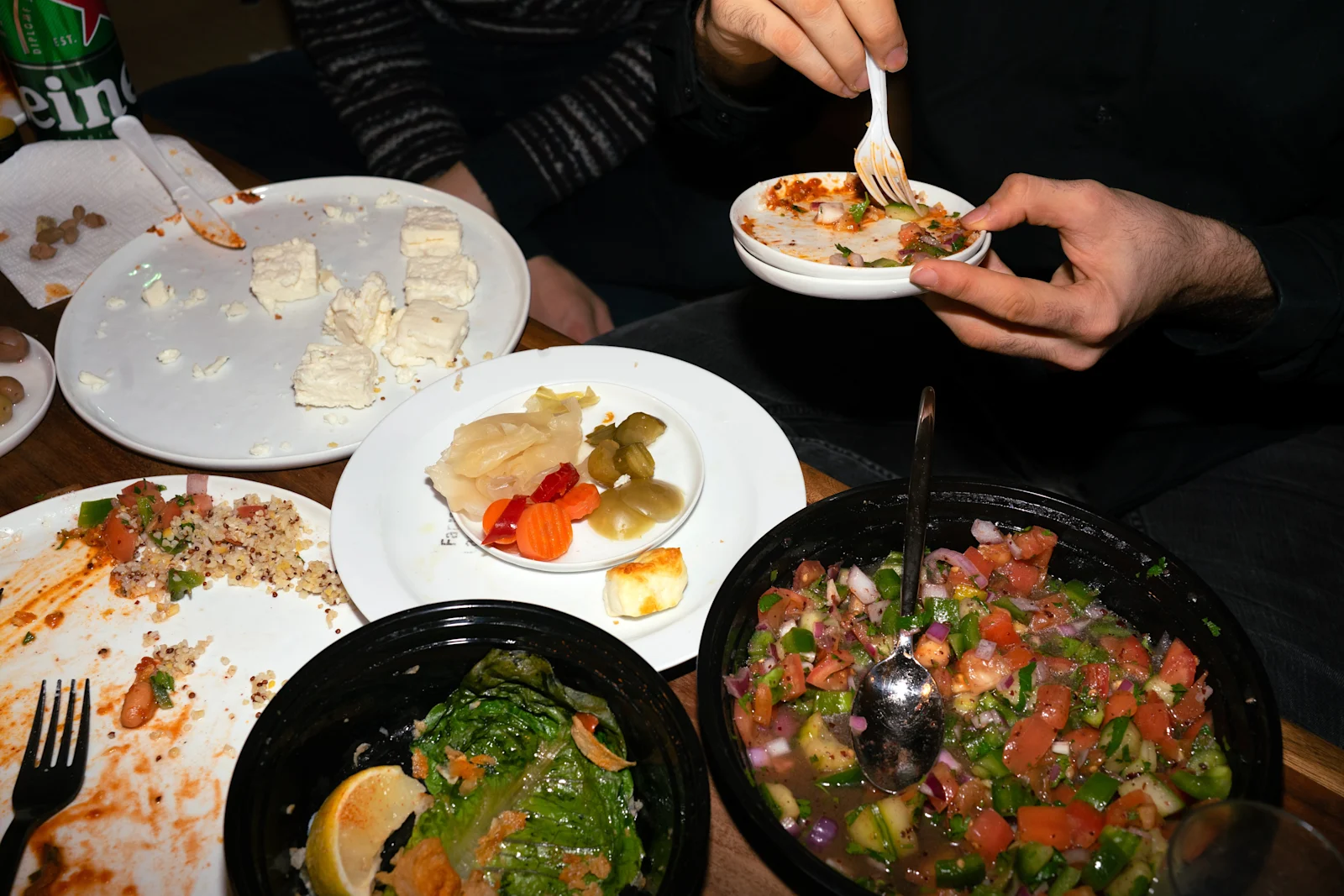
I grew up in Turkey, where the table was rarely simply a place to eat. It was long, generous and usually a little too full. There were plates in the middle, bread passed from hand to hand, several conversations happening at once. Someone was always arriving late. Someone was always making room.
You didn't really begin until everyone was there.
And you didn't necessarily leave when the meal was finished.
So, it began with family.
When I encountered the word sobremesa the time spent lingering around the table after a meal, it felt very familiar. It reminded me of a culture of not rushing away from the table, of staying because the conversation was still going, because there was something else to tell, or simply because there was no reason to leave yet.
I loved that there was a word for it.
Not because Turkish and Spanish traditions are the same, but because the feeling was familiar: the idea that being together can be reason enough to stay.
This became one of the starting points for us to join Sobremesa.
At Lisbon Art Weekend, we are interested in the ways contemporary art can create situations for people to encounter one another. We work with exhibitions, performances, talks and public programmes, but also with the less defined spaces that form around them, the conversations before and after, the encounters that don't necessarily have a programme, the time spent together.
Sobremesa makes us look at one of those spaces more closely: the table.
What happens when the table becomes a public space?
What happens when people who don't know each other sit together? When an artist brings a story to the table and a community brings its own?
For us, food is not simply the subject of Sobremesa. It is a way of bringing people together and a starting point for thinking about the things that food carries with it: migration, memory, identity, labour, family and belonging.
People have always moved. Food moves with them. Ingredients, recipes, gestures and tastes travel, change and adapt. A dish might remain connected to a place left behind, while becoming part of a new place. A recipe can be passed between generations, altered by necessity, or remembered without ever being written down.
These ordinary things can tell us a great deal about how people make and remake a sense of home.
This is where Sobremesa becomes public for us.
We want to create situations where these experiences can meet, where personal memories are not simply shared as stories, but can become points of exchange between people who may have very different relationships to food, place and belonging.
The table is useful here because it is familiar. Almost everyone has a memory of one. It might be a family table, a shared kitchen, a restaurant, a school canteen, a table at work, or somewhere temporary. Some tables are crowded, some are deliberately exclusive. Some are places of comfort, others of obligation. We are interested in what happens when different experiences of the table come into contact.
For Lisbon Art Weekend, Sobremesa is therefore also an invitation to think about how we gather.
It starts from something very ordinary - eating together - and opens it up to questions that are less ordinary. What do we carry with us? What do we remember through food? What changes when a tradition moves? What can happen when different histories meet around the same table?
Thinking about those long tables I grew up around, where we waited for everyone before beginning.
Perhaps that is what sobremesa means to me now: not the meal itself, but the time we make for one another around it.
Merve Pakyürek
Co-founder, Lisbon Art Weekend
Published October 1, 2026
Author: Merve Pakyürek Co-founder, Lisbon Art Weekend
Credit image: Maria Giovanna Giugliano
I grew up in Turkey, where the table was rarely simply a place to eat. It was long, generous and usually a little too full. There were plates in the middle, bread passed from hand to hand, several conversations happening at once. Someone was always arriving late. Someone was always making room.
You didn't really begin until everyone was there.
And you didn't necessarily leave when the meal was finished.
So, it began with family.
When I encountered the word sobremesa the time spent lingering around the table after a meal, it felt very familiar. It reminded me of a culture of not rushing away from the table, of staying because the conversation was still going, because there was something else to tell, or simply because there was no reason to leave yet.
I loved that there was a word for it.
Not because Turkish and Spanish traditions are the same, but because the feeling was familiar: the idea that being together can be reason enough to stay.
This became one of the starting points for us to join Sobremesa.
At Lisbon Art Weekend, we are interested in the ways contemporary art can create situations for people to encounter one another. We work with exhibitions, performances, talks and public programmes, but also with the less defined spaces that form around them, the conversations before and after, the encounters that don't necessarily have a programme, the time spent together.
Sobremesa makes us look at one of those spaces more closely: the table.
What happens when the table becomes a public space?
What happens when people who don't know each other sit together? When an artist brings a story to the table and a community brings its own?
For us, food is not simply the subject of Sobremesa. It is a way of bringing people together and a starting point for thinking about the things that food carries with it: migration, memory, identity, labour, family and belonging.
People have always moved. Food moves with them. Ingredients, recipes, gestures and tastes travel, change and adapt. A dish might remain connected to a place left behind, while becoming part of a new place. A recipe can be passed between generations, altered by necessity, or remembered without ever being written down.
These ordinary things can tell us a great deal about how people make and remake a sense of home.
This is where Sobremesa becomes public for us.
We want to create situations where these experiences can meet, where personal memories are not simply shared as stories, but can become points of exchange between people who may have very different relationships to food, place and belonging.
The table is useful here because it is familiar. Almost everyone has a memory of one. It might be a family table, a shared kitchen, a restaurant, a school canteen, a table at work, or somewhere temporary. Some tables are crowded, some are deliberately exclusive. Some are places of comfort, others of obligation. We are interested in what happens when different experiences of the table come into contact.
For Lisbon Art Weekend, Sobremesa is therefore also an invitation to think about how we gather.
It starts from something very ordinary - eating together - and opens it up to questions that are less ordinary. What do we carry with us? What do we remember through food? What changes when a tradition moves? What can happen when different histories meet around the same table?
Thinking about those long tables I grew up around, where we waited for everyone before beginning.
Perhaps that is what sobremesa means to me now: not the meal itself, but the time we make for one another around it.
Merve Pakyürek
Co-founder, Lisbon Art Weekend