Upper Crust, Whose Taste Belongs?
How much does a Tosta Mista cost today? From being the low-cost street food to Lisbon “experience”, today the cost of a toast mirrors the city's gentrification patterns. An article on taste, lifestyle migration, and transnational gentrification in Lisbon.
Upper Crust, Whose Taste Belongs?
How much does a Tosta Mista cost today? From being the low-cost street food to Lisbon “experience”, today the cost of a toast mirrors the city's gentrification patterns. An article on taste, lifestyle migration, and transnational gentrification in Lisbon.
Published October 14, 2026
Juliette Thouin, echoes residency
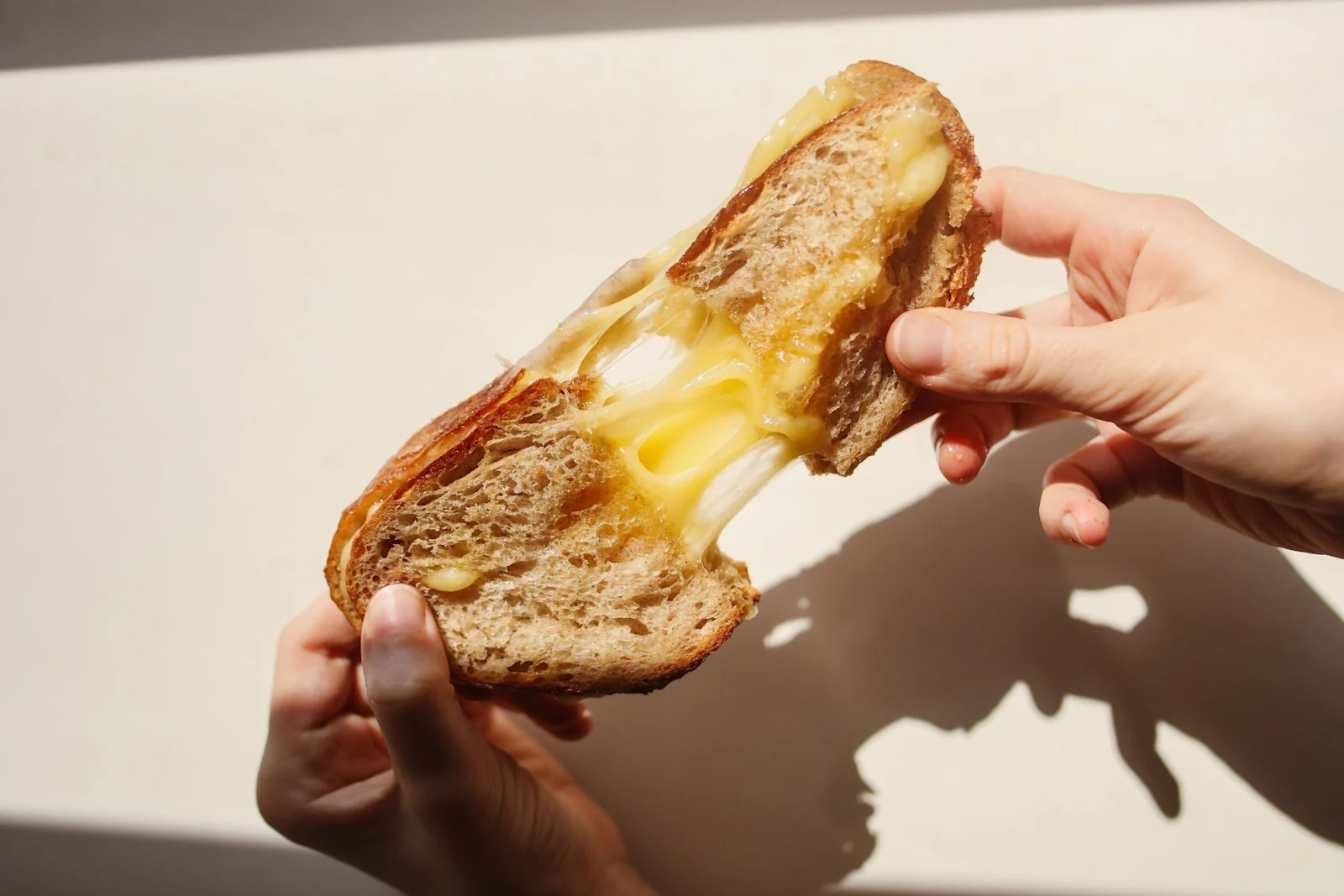
Credit image: Polina Tankilevitch / Pexels
If you have ever visited Lisbon or Portugal, chances are you have encountered a tosta. The tosta mista—a classic Portuguese ham and cheese grilled sandwich—is a staple found across local cafes, served hot and well-pressed. Its components are beautifully simple: bread, butter, ham, cheese, and a pinch of oregano.
Historically, the tosta mista is a localized cousin of the French croque monsieur, which emerged in late 19th-century Paris as an improvised bar snack—toast, butter, Gruyère, and ham created when traditional ham sandwiches grew monotonous. When crossing into Portugal, this culinary concept evolved along two distinct lines. In Porto, it transformed into the ambitious francesinha, created in 1953 by Daniel da Silva to adapt the Belgian and French traditions to local tastes using multiple meats, a rich beer-and-tomato sauce, and a fried egg. Across the rest of the country, it remained closer to its origin, establishing itself as the quintessential tosta mista.
A neighbourhood price
Over the past decade, Lisbon shifted from being one of Western Europe's most accessible capitals in price-to-income ratios to ranking as its least affordable city in 2025, according to Numbeo data. Between 2014 and 2024, real estate values in the historic center soared by over 200%, a steep rise mirrored in the cost of everyday food items.
In Anjos—a neighborhood dubbed “The Brooklyn of Lisbon”—a modern sandwich shop named Tosta opened its doors last year. Not coincidentally, the shop features in global rankings that list Anjos among the world's trendiest districts, highlighting its cluster of specialty coffee spots, natural wine bars, and independent boutiques. The evolution of neighborhoods into trendy destination spots is a well-established phenomenon, yet it extends beyond mere real estate displacement. Commercial gentrification operates as a cultural process as much as an economic one; the tastes of newcomers and incoming capital reinforce each other, creating a distinct aesthetic landscape.
This visual and aesthetic coding serves as a primary mechanism of distinction. As sociologist Pierre Bourdieu observed in the 1960s, taste acts as a subtle social marker that reinforces class positions and boundaries, often operating without conscious sorting. In contemporary urban landscapes, this manifests in a recognizable playbook: art galleries, boutique shops, and artisanal cafes that form what scholars describe as the standard landscape of gentrification. Gentrification carries a consistent visual tone and palette across disparate global cities, appearing remarkably similar whether in Lisbon, Berlin, Brooklyn, or Bali. This dynamic reflects a transnational shift, where tastes and business models move seamlessly across international borders through globalized social and economic networks.
In this context of transnational gentrification, food cultures serve as a key infrastructure that sustains and connects a mobile class of privileged international residents. When asked about their choice of menu, the owners of Tosta remarked that Lisbon had fewer specialized sandwich options compared to London or Paris. Regarding pricing, they emphasized a commitment to "neighborhood" rates, aiming to offer a sandwich and a glass of wine for under 12 euros. Yet in a country where the minimum hourly wage sits around 6 euros, a 12-euro lunch only feels like a neighborhood price after accepting the 200% surge in local property values—illustrating how thoroughly gentrification standards have been integrated into local commerce.
What prompts international entrepreneurs to launch a food venture in a new city? For many, the core expertise lies in leveraging aesthetic sensibilities rather than deep background in hospitality. The founders noted moving to Lisbon to establish a creative agency before launching culinary projects, hiring experienced staff to handle technical execution. This intersection of design, branding, and food highlights how culinary spaces function as central components in urban transformations.
Lifestyle in migration
This path reflects a broader pattern observed in contemporary urban mobility. Urban sociologist Franz Buhr notes that modern lifestyle entrepreneurs frequently arrive with significant cultural and financial capital, transitioning from corporate or creative backgrounds. Their moves are often driven by lifestyle optimization, establishing businesses that cater to a similar demographic of mobile, international residents. Sociologist Matthew Hayes conceptualizes these choices as "geoarbitrage"—leveraging disparities in living costs, taxation, and lifestyle quality across national borders to maximize personal and professional mobility. In academic research, this demographic is referred to as “lifestyle migrants”, though individuals often identify as digital nomads, expatriates, or temporary residents. These personal choices intersect directly with structural policy. Over the past decade, national initiatives designed to attract foreign investment—such as preferential tax regimes and flexible lodging regulations—facilitated these shifting urban dynamics, transforming local real estate and commercial landscapes.
At the neighborhood level, the expansion of commercial spaces tailored to mobile international residents subtly alters daily interactions. In conversations with longtime residents in Anjos, many express a quiet adjustment to these changes, where English increasingly becomes a default medium in local commercial establishments. Rather than individual intent, the broader structural shift refashions urban environments around specific lifestyle and consumption models, reshaping neighborhood commercial centers and social spaces. This dynamic of lifestyle migration highlights how commercial infrastructure can introduce standardized global forms into local cultural contexts, reshaping traditional neighborhood identity.
Food performing own global mobility
These venues display a remarkably consistent aesthetic and culinary vocabulary across cities: specialty coffee, natural wines, sourdough toasts, and global condiments like kimchi or matcha. Through this lifestyle infrastructure, culinary traditions are recombined into portable, international offerings—food that actively reflects and performs its own global mobility.
In "Eating the Other," bell hooks explores how “othered” people and cultures are often commodified through taste and aesthetics, framed as signals of cosmopolitan openness. When culinary elements are detached from their original contexts and integrated into global lifestyle menus, they function as markers of cultural fluency within internationalized social spaces.
In the context of lifestyle migration, this cosmopolitan palate reflects what sociologists term cultural “omnivorousness”—the ability to navigate fluently across diverse global traditions and aesthetics. Updating Bourdieu’s analysis for a globalized era, this culinary mobility operates as a contemporary social marker, defining who navigates these hybrid urban spaces with ease.
Taste, in this sense, isn't only a marker of who belongs once they arrive, it’s part of what decides where next and where else. Transnational gentrification has become a crucial concern across Europe, beyond local apprehensions in Lisbon. Who gets to live in, use and shape European cities is a question that a panel of architects, housing justice activists, urban planners and researchers will also be discussing during the 2026 edition of TRANSEUROPA festival taking place in Athens. The overarching question remains “a city for whom?”
References:
Michaela Benson, Karen O’Reilly, From lifestyle migration to lifestyle in migration: Categories, concepts and ways of thinking , Migration Studies, Volume 4, Issue 1, March 2016, Pages 20–37, https://doi.org/10.1093/migration/mnv015
Buhr, F., Zaban, H. (2026). Privilege in Migration: Mobilities, Inequalities, and the Urban Context. In: Zaban, H., Buhr, F. (eds) Privilege in Migration. IMISCOE Research Series. Springer, Cham. https://doi.org/10.1007/978-3-032-29885-0_1
Buhr, F. (2026). Privileged Mobilities and Migrants’ Businesses in Lisbon: Migrant Entrepreneurship in a Lifestyle Destination. In: Zaban, H., Buhr, F. (eds) Privilege in Migration. IMISCOE Research Series. Springer, Cham. https://doi.org/10.1007/978-3-032-29885-0_10
Buhr, F. (2026). Estilos de vida móveis e suas infraestruturas: notas sobre Lisboa. Revista Brasileira de Sociologia, vol. 11, núm. 28, pp. 98-118, 2023 https://www.redalyc.org/journal/5957/595776119005/html/
Bourdieu, P. (1984). Distinction: A social critique of the judgement of taste (R. Nice, Trans.). Harvard University Press. (Original work published 1979)
Cocola-Gant, A. 25/06/2025. How Lisbon put itself on the map for real estate and tourism – and became Europe’s least affordable city https://www.theguardian.com/commentisfree/2025/jun/25/lisbon-europe-portugal-golden-visa-capital-investors-short-term-rentals
Hooks, Bell. "Eating the Other: Desire and Resistance." In Black Looks: Race and Representation, 21–39. Boston: South End Press, 1992.
Vidal, D. 23/06/2025. As novas sanduíches de autor de Lisboa são uma refeição completa por 10€. https://www.nit.pt/comida/restaurantes/sanduiches-de-autor-lisboa-refeicao-completa-10e
Alkon, Alison Hope, Yuki Kato, and Joshua Sbicca, eds. 2020. A Recipe for Gentrification: Food, Power, and Resistance in the City. New York: New York University Press
Bantman-Masum, E. (2020). Unpacking commercial gentrification in central Paris. Urban Studies, 57(15), 3135-3150. https://doi.org/10.1177/0042098019865893
Molina Caminero, L. 04.06.2026. From “Expat Paradise” to Urban Frictions: Lisbon and the Infrastructures of Privileged Migration https://www.eurac.edu/en/blogs/mobile-people-and-diverse-societies/from-expat-paradise-to-urban-frictions-lisbon-and-the-infrastructures-of-privileg-
Peterson, Richard A., and Roger M. Kern. “Changing Highbrow Taste: From Snob to Omnivore.” American Sociological Review 61, no. 5 (1996): 900–907. https://doi.org/10.2307/2096460.
Published October 14, 2026
Juliette Thouin, echoes residency
Credit image: Polina Tankilevitch / Pexels
If you have ever visited Lisbon or Portugal, chances are you have encountered a tosta. The tosta mista—a classic Portuguese ham and cheese grilled sandwich—is a staple found across local cafes, served hot and well-pressed. Its components are beautifully simple: bread, butter, ham, cheese, and a pinch of oregano.
Historically, the tosta mista is a localized cousin of the French croque monsieur, which emerged in late 19th-century Paris as an improvised bar snack—toast, butter, Gruyère, and ham created when traditional ham sandwiches grew monotonous. When crossing into Portugal, this culinary concept evolved along two distinct lines. In Porto, it transformed into the ambitious francesinha, created in 1953 by Daniel da Silva to adapt the Belgian and French traditions to local tastes using multiple meats, a rich beer-and-tomato sauce, and a fried egg. Across the rest of the country, it remained closer to its origin, establishing itself as the quintessential tosta mista.
A neighbourhood price
Over the past decade, Lisbon shifted from being one of Western Europe's most accessible capitals in price-to-income ratios to ranking as its least affordable city in 2025, according to Numbeo data. Between 2014 and 2024, real estate values in the historic center soared by over 200%, a steep rise mirrored in the cost of everyday food items.
In Anjos—a neighborhood dubbed “The Brooklyn of Lisbon”—a modern sandwich shop named Tosta opened its doors last year. Not coincidentally, the shop features in global rankings that list Anjos among the world's trendiest districts, highlighting its cluster of specialty coffee spots, natural wine bars, and independent boutiques. The evolution of neighborhoods into trendy destination spots is a well-established phenomenon, yet it extends beyond mere real estate displacement. Commercial gentrification operates as a cultural process as much as an economic one; the tastes of newcomers and incoming capital reinforce each other, creating a distinct aesthetic landscape.
This visual and aesthetic coding serves as a primary mechanism of distinction. As sociologist Pierre Bourdieu observed in the 1960s, taste acts as a subtle social marker that reinforces class positions and boundaries, often operating without conscious sorting. In contemporary urban landscapes, this manifests in a recognizable playbook: art galleries, boutique shops, and artisanal cafes that form what scholars describe as the standard landscape of gentrification. Gentrification carries a consistent visual tone and palette across disparate global cities, appearing remarkably similar whether in Lisbon, Berlin, Brooklyn, or Bali. This dynamic reflects a transnational shift, where tastes and business models move seamlessly across international borders through globalized social and economic networks.
In this context of transnational gentrification, food cultures serve as a key infrastructure that sustains and connects a mobile class of privileged international residents. When asked about their choice of menu, the owners of Tosta remarked that Lisbon had fewer specialized sandwich options compared to London or Paris. Regarding pricing, they emphasized a commitment to "neighborhood" rates, aiming to offer a sandwich and a glass of wine for under 12 euros. Yet in a country where the minimum hourly wage sits around 6 euros, a 12-euro lunch only feels like a neighborhood price after accepting the 200% surge in local property values—illustrating how thoroughly gentrification standards have been integrated into local commerce.
What prompts international entrepreneurs to launch a food venture in a new city? For many, the core expertise lies in leveraging aesthetic sensibilities rather than deep background in hospitality. The founders noted moving to Lisbon to establish a creative agency before launching culinary projects, hiring experienced staff to handle technical execution. This intersection of design, branding, and food highlights how culinary spaces function as central components in urban transformations.
Lifestyle in migration
This path reflects a broader pattern observed in contemporary urban mobility. Urban sociologist Franz Buhr notes that modern lifestyle entrepreneurs frequently arrive with significant cultural and financial capital, transitioning from corporate or creative backgrounds. Their moves are often driven by lifestyle optimization, establishing businesses that cater to a similar demographic of mobile, international residents. Sociologist Matthew Hayes conceptualizes these choices as "geoarbitrage"—leveraging disparities in living costs, taxation, and lifestyle quality across national borders to maximize personal and professional mobility. In academic research, this demographic is referred to as “lifestyle migrants”, though individuals often identify as digital nomads, expatriates, or temporary residents. These personal choices intersect directly with structural policy. Over the past decade, national initiatives designed to attract foreign investment—such as preferential tax regimes and flexible lodging regulations—facilitated these shifting urban dynamics, transforming local real estate and commercial landscapes.
At the neighborhood level, the expansion of commercial spaces tailored to mobile international residents subtly alters daily interactions. In conversations with longtime residents in Anjos, many express a quiet adjustment to these changes, where English increasingly becomes a default medium in local commercial establishments. Rather than individual intent, the broader structural shift refashions urban environments around specific lifestyle and consumption models, reshaping neighborhood commercial centers and social spaces. This dynamic of lifestyle migration highlights how commercial infrastructure can introduce standardized global forms into local cultural contexts, reshaping traditional neighborhood identity.
Food performing own global mobility
These venues display a remarkably consistent aesthetic and culinary vocabulary across cities: specialty coffee, natural wines, sourdough toasts, and global condiments like kimchi or matcha. Through this lifestyle infrastructure, culinary traditions are recombined into portable, international offerings—food that actively reflects and performs its own global mobility.
In "Eating the Other," bell hooks explores how “othered” people and cultures are often commodified through taste and aesthetics, framed as signals of cosmopolitan openness. When culinary elements are detached from their original contexts and integrated into global lifestyle menus, they function as markers of cultural fluency within internationalized social spaces.
In the context of lifestyle migration, this cosmopolitan palate reflects what sociologists term cultural “omnivorousness”—the ability to navigate fluently across diverse global traditions and aesthetics. Updating Bourdieu’s analysis for a globalized era, this culinary mobility operates as a contemporary social marker, defining who navigates these hybrid urban spaces with ease.
Taste, in this sense, isn't only a marker of who belongs once they arrive, it’s part of what decides where next and where else. Transnational gentrification has become a crucial concern across Europe, beyond local apprehensions in Lisbon. Who gets to live in, use and shape European cities is a question that a panel of architects, housing justice activists, urban planners and researchers will also be discussing during the 2026 edition of TRANSEUROPA festival taking place in Athens. The overarching question remains “a city for whom?”
References:
Michaela Benson, Karen O’Reilly, From lifestyle migration to lifestyle in migration: Categories, concepts and ways of thinking , Migration Studies, Volume 4, Issue 1, March 2016, Pages 20–37, https://doi.org/10.1093/migration/mnv015
Buhr, F., Zaban, H. (2026). Privilege in Migration: Mobilities, Inequalities, and the Urban Context. In: Zaban, H., Buhr, F. (eds) Privilege in Migration. IMISCOE Research Series. Springer, Cham. https://doi.org/10.1007/978-3-032-29885-0_1
Buhr, F. (2026). Privileged Mobilities and Migrants’ Businesses in Lisbon: Migrant Entrepreneurship in a Lifestyle Destination. In: Zaban, H., Buhr, F. (eds) Privilege in Migration. IMISCOE Research Series. Springer, Cham. https://doi.org/10.1007/978-3-032-29885-0_10
Buhr, F. (2026). Estilos de vida móveis e suas infraestruturas: notas sobre Lisboa. Revista Brasileira de Sociologia, vol. 11, núm. 28, pp. 98-118, 2023 https://www.redalyc.org/journal/5957/595776119005/html/
Bourdieu, P. (1984). Distinction: A social critique of the judgement of taste (R. Nice, Trans.). Harvard University Press. (Original work published 1979)
Cocola-Gant, A. 25/06/2025. How Lisbon put itself on the map for real estate and tourism – and became Europe’s least affordable city https://www.theguardian.com/commentisfree/2025/jun/25/lisbon-europe-portugal-golden-visa-capital-investors-short-term-rentals
Hooks, Bell. "Eating the Other: Desire and Resistance." In Black Looks: Race and Representation, 21–39. Boston: South End Press, 1992.
Vidal, D. 23/06/2025. As novas sanduíches de autor de Lisboa são uma refeição completa por 10€. https://www.nit.pt/comida/restaurantes/sanduiches-de-autor-lisboa-refeicao-completa-10e
Alkon, Alison Hope, Yuki Kato, and Joshua Sbicca, eds. 2020. A Recipe for Gentrification: Food, Power, and Resistance in the City. New York: New York University Press
Bantman-Masum, E. (2020). Unpacking commercial gentrification in central Paris. Urban Studies, 57(15), 3135-3150. https://doi.org/10.1177/0042098019865893
Molina Caminero, L. 04.06.2026. From “Expat Paradise” to Urban Frictions: Lisbon and the Infrastructures of Privileged Migration https://www.eurac.edu/en/blogs/mobile-people-and-diverse-societies/from-expat-paradise-to-urban-frictions-lisbon-and-the-infrastructures-of-privileg-
Peterson, Richard A., and Roger M. Kern. “Changing Highbrow Taste: From Snob to Omnivore.” American Sociological Review 61, no. 5 (1996): 900–907. https://doi.org/10.2307/2096460.